
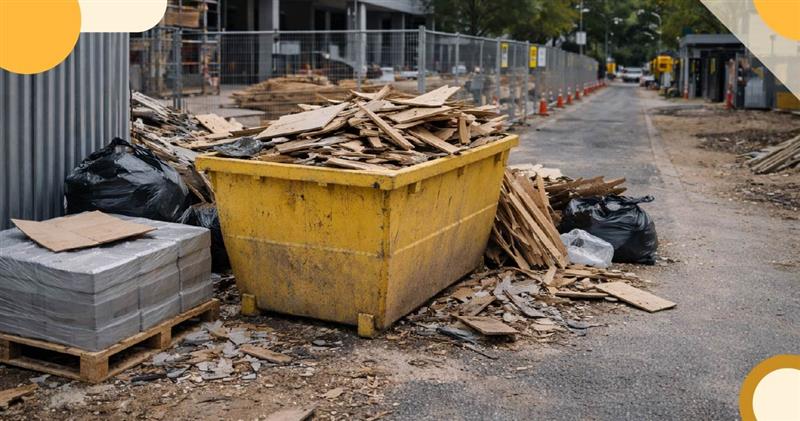
On Canberra worksites, the smallest skip bin is often booked because it looks efficient. Lower upfront cost. Smaller footprint. Easier to justify quickly.
In practice, this is one of the most common misalignments between bin selection and how commercial sites in the ACT actually operate. The problem is not choosing a small skip bin. The problem is choosing it without aligning it to waste flow, access conditions, and project sequencing.
Across trade, construction, and commercial projects in Canberra, this mismatch consistently shows up as re bookings, disrupted schedules, and unnecessary coordination pressure.
Small Bins Work When Conditions Are Controlled
Small skip bins are not wrong by default.
They work on short duration tasks, genuinely low waste output, tight access locations, and projects designed around frequent scheduled collections. When those conditions are present, small bins support order and control.
Issues start when the same bin size is applied to sites with multiple trades, packaging waste, and variable output, where waste accumulates faster than planned.
Where the Misalignment Begins
Waste volume is almost always underestimated.
Packaging from materials, offcuts, broken pallets, protective wraps, and incidental debris appear earlier and in greater volume than expected. These rarely show up accurately in early planning assumptions.
When output exceeds estimates, a small bin reaches capacity quickly. Once that happens, flexibility disappears.
Waste cannot be legally overfilled. It cannot be stored around the bin without creating safety and access issues. The site starts adapting around waste instead of progressing work. At that point, the bin is no longer a cost control decision. It becomes an operational constraint.
The Second Booking Exposes the Real Cost
When a small bin fills early, a second booking becomes unavoidable. In Canberra, this is where the decision is tested, with considerations such as access windows, shared commercial driveways, and timing restrictions. ACT council placement requirements mean that a public land permit must be obtained whenever public space is used.
What was planned as a single controlled hire becomes two separate operational events. Two deliveries. Two collections. Extra coordination. Extra administration. The combined cost almost always exceeds what a correctly sized bin would have cost from the start.
What This Looks Like on ACT Commercial Sites
This pattern appears regularly on commercial fit outs and staged refurbishments.
A small bin is booked for an initial phase. It fills earlier than expected. Waste from the next trade phase has nowhere to go. Crews slow down while a replacement bin is arranged.
On sites with limited street access or shared driveways, collections move to the next available window, not the one the site needs. The project does not stall because of labour or materials. It stalls because waste removal was undersized.
Compliance Pressure Does Not Reduce with Size
Smaller bins are often assumed to be easier under ACT council requirements. In reality, placement and compliance expectations apply regardless of bin size.
If a bin occupies public land, footpaths, verges, or shared access areas, approvals and correct positioning still apply. When additional bins are introduced reactively, placement decisions are compressed.
That compression increases exposure, not because the bin is small, but because the margin for planning has been removed.
Predictability Is What Actually Controls Cost
For Canberra businesses, labour efficiency and site flow outweigh marginal differences in hire pricing.
Predictable waste removal keeps crews moving, reduces decision points, and protects schedules.
A bin that lasts the full stage of work does exactly that. Small bins remove buffer. Larger bins absorb variability. Neither is inherently right or wrong. Fit to operating conditions is what determines outcome.
Recommended Reads: Cheap Skip Bins in Canberra: Where the Hidden Costs Usually Appear
Choose Capacity Based on How Your Site Runs
Skip bin hire in Canberra is not about choosing the smallest option available. It is about choosing capacity that matches waste output, access constraints, and project sequencing.
When bin size is aligned correctly, sites run cleaner, schedules hold, and re bookings disappear. That alignment is exactly how skip bin hire is structured at Skip Bins Canberra.
If your project already has defined access, timing, and waste flow, booking the right capacity upfront removes friction before it starts. Choose capacity that keeps your site moving.